Perception rescues 3D reconstruction where generative priors fail
1Applied Artificial Intelligence Initiative, Deakin University 2School of Information Technology, Deakin University
The relationship between object perception and reconstruction is well established in human vision, yet remains underexplored in computer vision. In this paper, we demonstrate that learnt object perception can significantly enhance 3D reconstruction. Focusing on the challenging task of single-view 3D object reconstruction, we propose a method that leverages perceptual signals extracted from pretrained perception models — capturing semantic and geometric information — to drive the reconstruction of an object from its single image. Our approach is model-agnostic and can be integrated into various reconstruction methods in a plug-and-play manner. Experiments with two state-of-the-art single-view 3D reconstruction pipelines on a benchmark dataset show consistent and substantial improvements, validating the effectiveness of incorporating perception into generation. We provide in-depth analysis of various aspects of our method and its application. To support future research, we will release our code and pretrained models.
Multi-view diffusion models hallucinate geometry from a learned prior. When that prior is wrong, the reconstruction fails. We attach a lightweight Generation-Perception Alignment module to a frozen diffusion backbone — a Feature Aggregation network and modality-specific Perception Mappers that predict what pre-trained perception models “see” in the object, then use the mismatch to steer the denoising latents at inference.
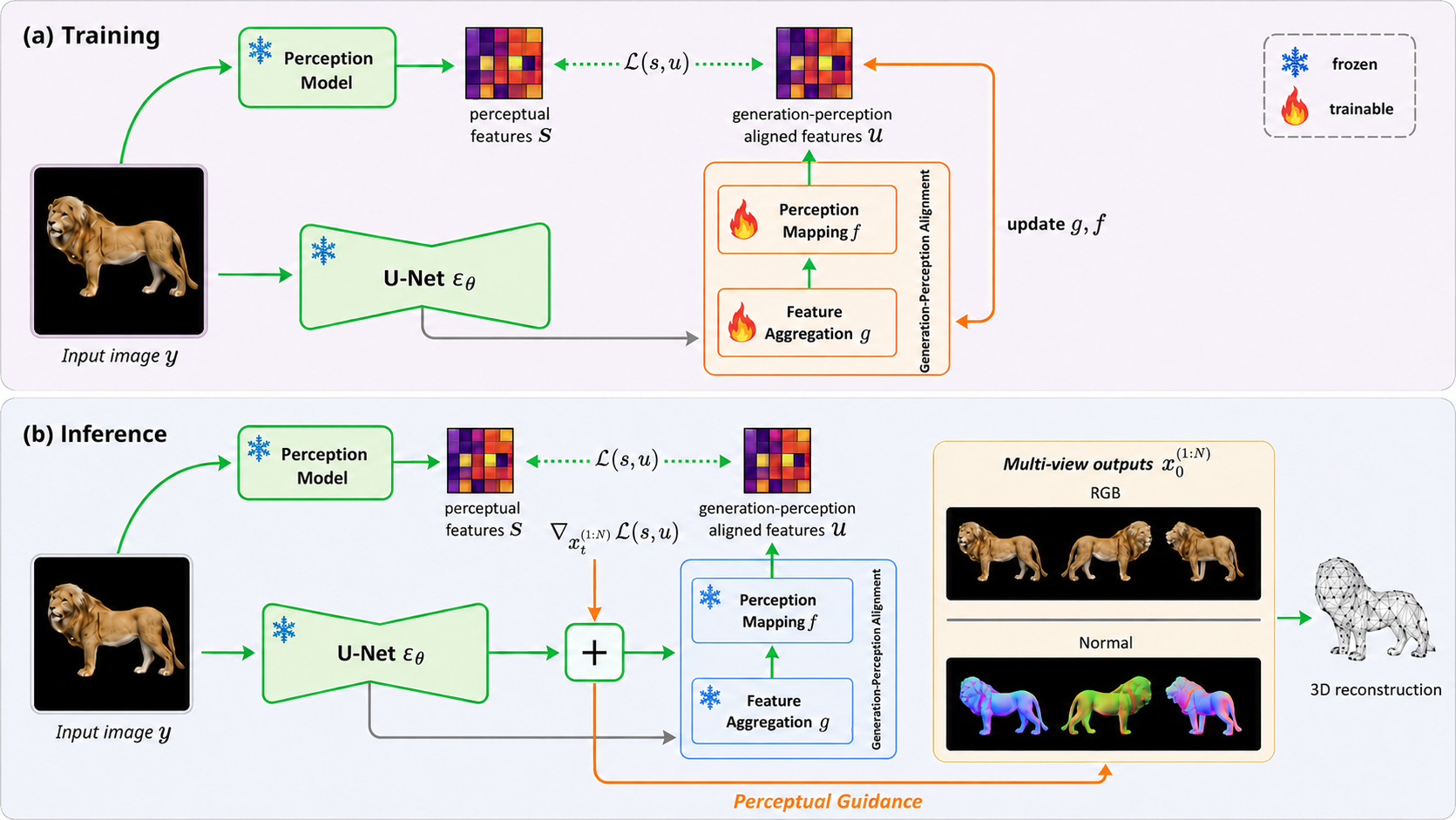
Pre-trained models capture semantic knowledge (a VLM + LLM caption, embedded with CLIP) and geometric knowledge (Depth‑Anything V2) from the single input image.
Forward hooks on the frozen U-Net decoder feed a Feature Aggregation network. Modality-specific Perception Mappers project these features toward the perceptual targets — the only trained parameters in the system.
At inference, gradients from the perception loss flow back through the frozen network to the noisy latents $x_t$, steering DDIM sampling toward perceptually consistent multi-view outputs.

Before guiding generation, our perception modules extract two complementary views of the object — one of what it is, one of how it is shaped.
A vision-language model describes the object in natural language; the caption is embedded into a single view-invariant semantic vector that anchors its identity.
“a vintage-style alarm clock… round, rigid body with a metallic finish… a small loop handle… and a visible winding key on the side.”
“a classic fedora hat… light brown straw texture and a white band… a rounded dome and a flat brim that extends outward.”
“a tube of Moroccan argan-oil shampoo… cylindrical, slightly tapered shape with a rigid, smooth surface… the cap at the bottom.”
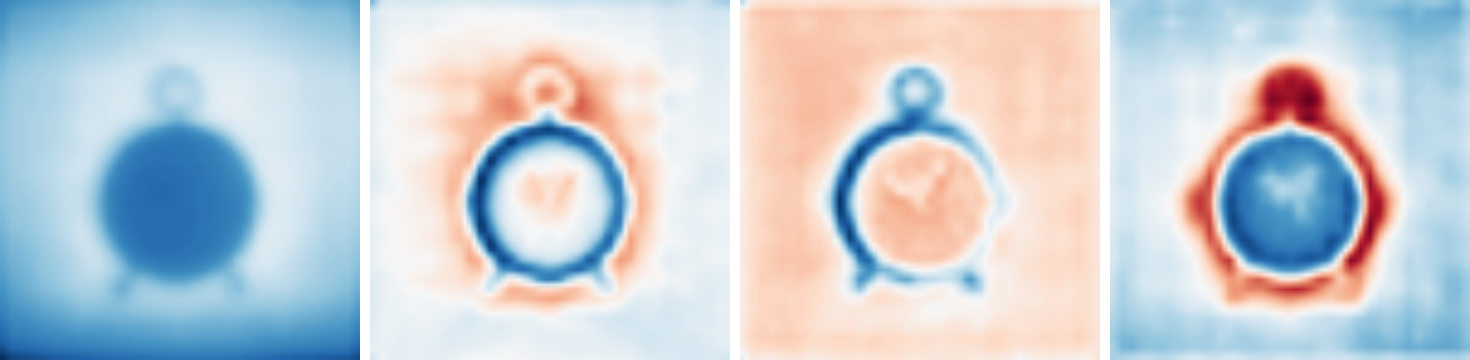
Depth-Anything V2 refinenet3 features. Four channels fire on distinct
structural concepts — far richer than a single depth map:


During training, the Perception Mappers learn to predict these targets from the frozen U-Net's internal features. At inference, the mismatch between prediction and target becomes the guidance signal that steers denoising.
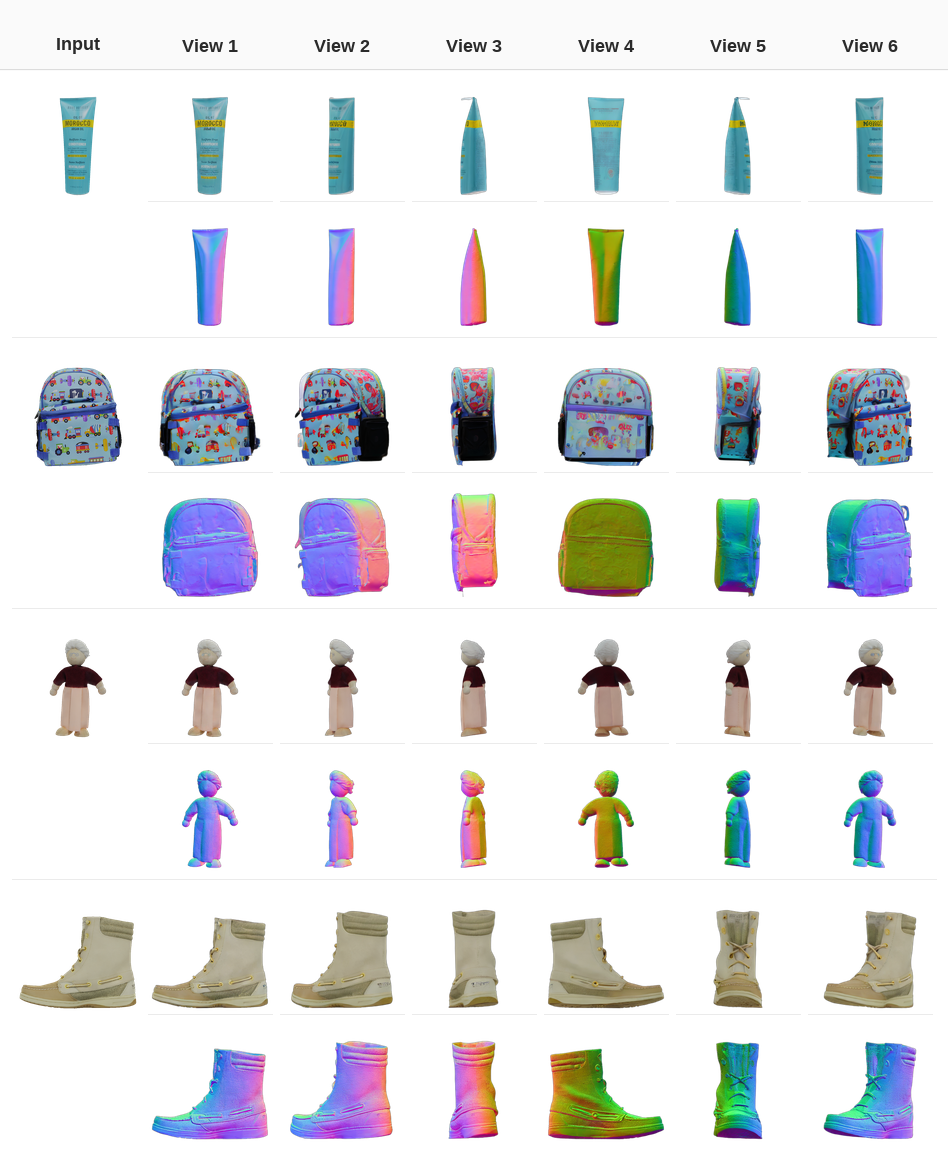
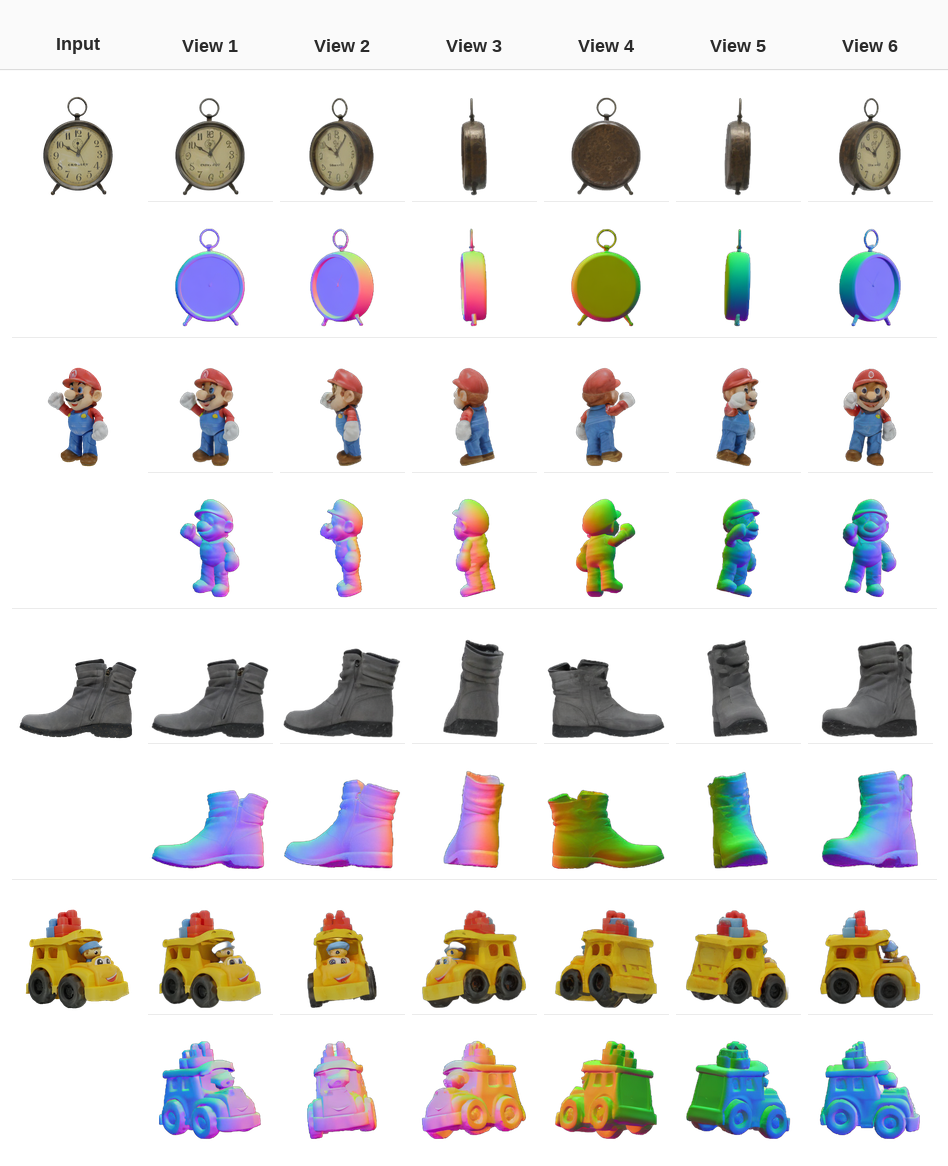
The same input, denoised with and without perception, side by side across all six views. At every DDIM step the Perception Mappers compare what the U-Net is generating against what perception expects and nudge the latents toward agreement. Each frame is the model's x̂0 prediction — all 40 steps, in sync.
Era3D six-view x̂0 prediction at every one of the 40 DDIM steps; combined guidance = depth + caption Perception Mappers. Rows are frame-synchronized.
GSO-30 benchmark. Chamfer Distance (CD, ×10−3) and volumetric IoU. The same depth + caption recipe improves both backbones.
| Setting | CD ↓ | IoU ↑ | PSNR ↑ | ΔCD |
|---|---|---|---|---|
| Wonder3D | 21.21 | 0.530 | 21.79 | — |
| + Depth | 20.18 | 0.534 | 21.86 | −4.3% |
| + Depth + Caption Ours | 19.30 | 0.538 | 21.86 | −9.0% |
| Era3D | 20.78 | 0.499 | 21.53 | — |
| + Depth | 14.46 | 0.561 | 21.80 | −30.4% |
| + Depth + Caption Ours | 13.99 | 0.558 | 22.05 | −32.7% |
Era3D comparison uses a matched, guidance-free pipeline baseline. Full metric tables (SSIM, LPIPS, ablations) are in the paper.
@article{huynh2026seeing,
title = {Seeing Before Generating: Object Perception
Enhances Single-View 3D Reconstruction},
author = {Huynh, Y and Nguyen, Duc Thanh and Abdelrazek, Mohamed},
journal = {arXiv preprint},
year = {2026}
}